:strip_icc()/pic2501050.jpg)
Anomia plays off the fact that our minds are positively brimming with all sorts of random information: things to eat, pop songs, websites, etc... Sure, under normal circumstances, it's easy to give an example of a frozen food or a dog breed, but you'll find that your brain works a little differently under pressure! To play, draw and reveal a card from the center pile. Does the symbol on your card match one on another player's card? If so, you must quickly face-off with the other player by giving an example of the person, place, or thing on their card before they can do the same for yours. If you blurt out a correct answer first, you win their card and the drawing continues. Sounds simple, right? Wrong! Wild cards allow non-matching symbols to match, increasing the number of things to which you must pay attention. Cascading face-offs can occur when you hand over a lost card, thereby revealing a new top card on your play pile.
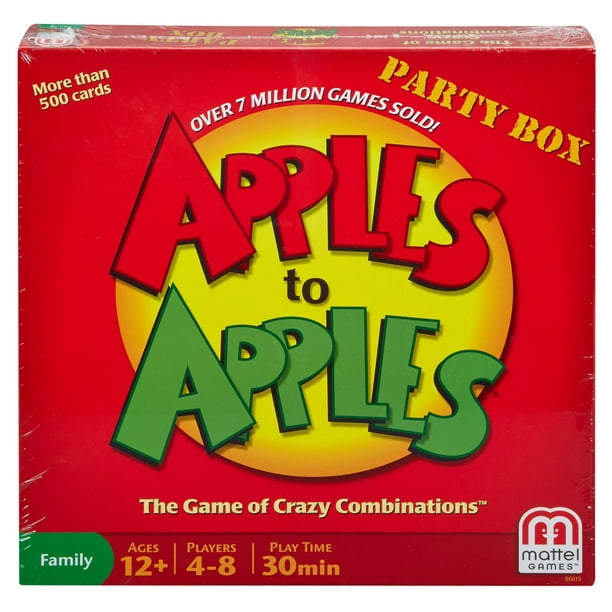
The party game Apples to Apples consists of two decks of cards: Things and Descriptions. Each round, the active player draws a Description card (which features an adjective like "Hairy" or "Smarmy") from the deck, then the other players each secretly choose the Thing card in hand that best matches that description and plays it face-down on the table. The active player then reveals these cards and chooses the Thing card that, in his opinion, best matches the Description card, which he awards to whoever played that Thing card. This player becomes the new active player for the next round. Once a player has won a pre-determined number of Description cards, that player wins. Note: "Party Box" editions include all cards from Apples to Apples: Expansion Set #1 and Apples to Apples: Expansion Set #2
:strip_icc()/pic605442.jpg)
Play as one of six characters from The Office, as their boss Michael Scott forces them to play a real-life game of Clue to determine who killed the HR rep, Toby. Gameplay is similar to standard Clue, with special "intrigue cards" new to the game. Intrigue cards come in two varieties: Clocks and Keepers. They are obtained in one of three ways: rolling a question mark on the included custome dice, landing on a question mark on the board, or if your character is moved to a room as part of someone starting a rumor (equivalent to Clue's "making a suggestion.") The first two situations incur a forced draw, while the third is optional. There are eight clock cards in the intrigue deck, and if you draw the eighth card then you automatically lose. Keepers give a one-time bonus that allow you to slightly alter some of the game's parameters...risk of drawing a clock; potential reward of benefiting from a keeper. Additionally, each of the six characters have a "personality card" which alows for a one-time power. For example, Dwight's reads: "Once per game, you may move twice. Roll the dice, move, then roll again." The winner gets "an extra week of vacation" from Michael Scott!

Cockroach Poker is a reverse set collection game that has nothing to do with poker – except that the game is all about bluffing, with cards that show cockroaches, rats and stink bugs. The goal is to force another player to collect 4 of any one type of critter. The deck includes 64 cards, with eight copies of eight types of critters. To set up the game, shuffle the deck and deal the cards out to players. On a turn, a player takes one card from their hand, lays it face down on the table, slides it to a player of their choice, and declares a type of critter, e.g., "Stink bug". The player receiving the card either Accepts the card, says either "true" or "false", then reveals the card. If this player is wrong in their claim, they keep the card on the table in front of them face up; if they are right, the player who gave them the card places it face up before them. Peeks at the card, then passes it face down to another player, either saying the original type of critter or saying a new type. This new player again has the choice of accepting the card or passing it, unless the card has already been seen by all other players in which case the player must take the first option. Whoever lost a challenge and had to place the card before them on the table begins the next round. The game ends when a player has no cards to pass on their turn or when a player has four cards of the same critter on the table in front of them. In either case, this player loses and everyone else wins.

Two rival spymasters know the secret identities of 25 agents. Their teammates know the agents only by their codenames — single-word labels like "disease", "Germany", and "carrot". Yes, carrot. It's a legitimate codename. Each spymaster wants their team to identify their agents first...without uncovering the assassin by mistake. In Codenames, two teams compete to see who can make contact with all of their agents first. Lay out 25 cards, each bearing a single word. The spymasters look at a card showing the identity of each card, then take turns clueing their teammates. A clue consists of a single word and a number, with the number suggesting how many cards in play have some association to the given clue word. The teammates then identify one agent they think is on their team; if they're correct, they can keep guessing up to the stated number of times; if the agent belongs to the opposing team or is an innocent bystander, the team's turn ends; and if they fingered the assassin, they lose the game. Spymasters continue giving clues until one team has identified all of their agents or the assassin has removed one team from play.

A simple two-player game pitting the revolutionaries against the entrenched leader. Think of it as two-player Junta. The components are really flimsy (map and counters). The map is real simple, city and outlying sections, with victory locations (Radio/TV, Armoury, Capitol, etc.) scattered about. Small, but fun. Try this: You lose points for rubble-izing the city hexes...so you -have- to overrun...
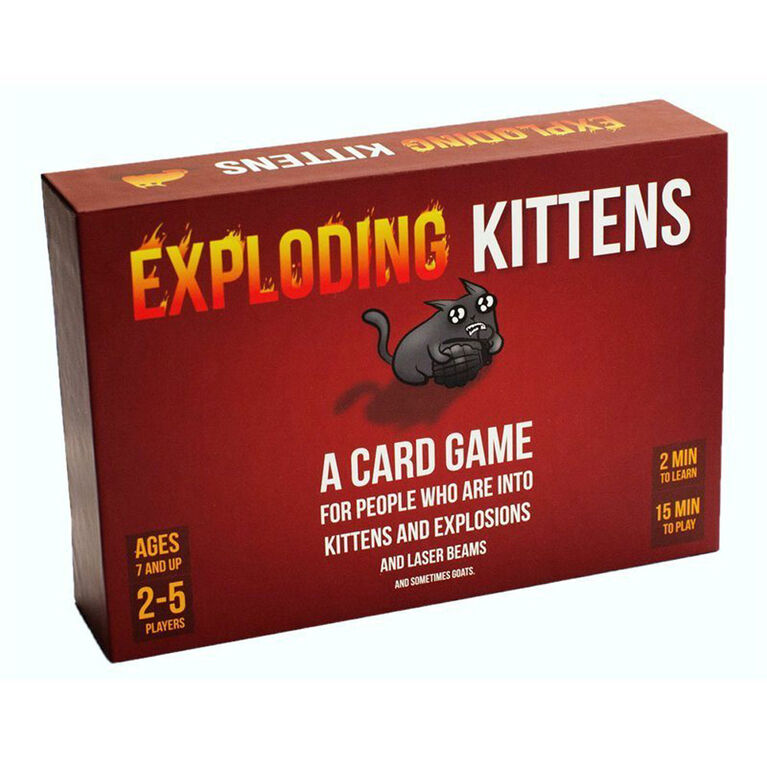
Exploding Kittens is a kitty-powered version of Russian Roulette. Players take turns drawing cards until someone draws an exploding kitten and loses the game. The deck is made up of cards that let you avoid exploding by peeking at cards before you draw, forcing your opponent to draw multiple cards, or shuffling the deck. The game gets more and more intense with each card you draw because fewer cards left in the deck means a greater chance of drawing the kitten and exploding in a fiery ball of feline hyperbole.
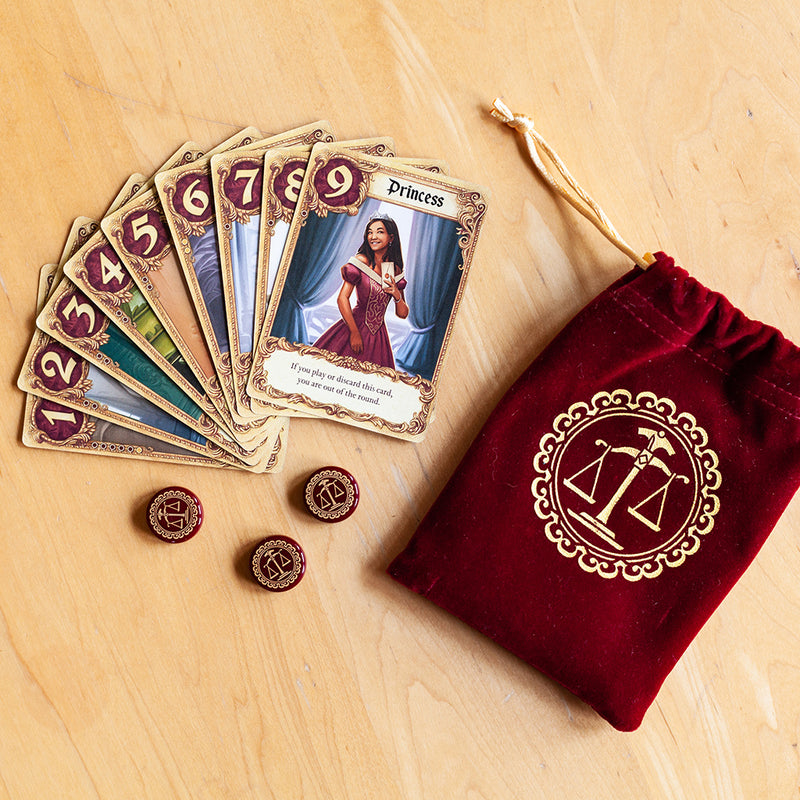
The noble Princess is looking for an ideal partner and confidant to help with her royal duties when she one day assumes the throne. You must prove your worth and gain her trust by enlisting allies, friends, and family of the Princess to carry a letter of intent to her. Can you earn the Princess' trust and become her confidant? Playing cards one at a time, players in Love Letter use the abilities of these key people in the Princess' life to outwit their opponents and successfully deliver their letter and gain her favor. Players must utilize each character's special skill to avoid being caught and successfully deliver their letter to the Princess. Once a set number of favor tokens are acquired, that player wins and becomes the Princess' confidant. This 2019 edition of Love Letter features new artwork by Citadels artist Andrew Bosley, screen-printed tokens, and two new characters (five cards in total) that allow for games with up to six players. When played, the Chancellor (value 6) allows you to draw two new cards, add those to your hand, then place two cards of your choice on the bottom of the deck. The Spy (value 0) wins you a favor token if you were the only player to play or discard a spy during the round. —description from the publisher

Monikers is a party game based on the public domain game Celebrities, where players take turns attempting to get their teammates to guess names by describing or imitating well-known people. In the first round, clue givers can say anything they want, except for the name itself. For the second round, clue givers can only say one word. And in the final round, clue givers can’t say anything at all: they can only use gestures and charades.

Strange and terrible things have begun happening in Hawkins, Indiana… better huddle down and break out a nice board game with your pals! Monopoly game with a Stranger Things theme Features 80s-inspired tokens and tokens “ripped from the Upside Down” Walkie-Talkie and Blinking Lights cards as Community Chest and Chance cards

Post apocalyptic football game. Based on the movie 'The Blood of Heroes'. The aim of the game is to get a 'dogskull' onto a spike at the opposing end of the field while preventing the opposing team from doing the same. The team of each player may choose between: Runner: The only piece allowed to touch the skull and score points. (mandatory) Chain: The piece with the greatest reach on the field and strong damage. Pole: Fighting piece able to block front field spaces. Net: Catch enemy pieces Hook: Pin enemy pieces Cards are used for movement and to determine the outcome of fights. The game comes in a video cassette box, with board, tokens and cards.

From the publisher (edited): Snake Oil - The medicine show card game! Step right up, ladies & gents! Make fantastic medical claims for your bottled elixir. Slander your opponents and steal their secrets! Avoid angry mobs and law enforcement while weaseling the highest price possible for your Snake-Oil! 3-4 players is ideal, but can be played by 2-8. From the rules: The Setting: In the latter part of the 19th Century and well into the 20th, an industry boomed across the American Midwest. That industry was the Medicine Show, where any entrepreneur with a questionable recipe and plenty of business savvy could pull his wagon up to the center of town and hawk his medicinal wares for a few cents per bottle. You and your opponents are these peddlers of “Snake-Oil”. The Object: In Snake-Oil, the object is to achieve the highest per bottle price for your elixir. To do this, you may have to hire thugs, slander your opponents and plant ringers in the crowd. But it’s all in good fun and, hey, you always have the next town for your opponents to get revenge. Game Length: A game of Snake-Oil can last is little as 5 minutes or as long as an hour, depending on how many towns you and your opponents decide to hit. Each hand of Snake-Oil constitutes a town. The game includes a score sheet with room for the name of your product and a running tally for three towns. When you’ve played the number of hands you’ve agreed upon, add up the totals for each town and the winner is the player with the highest total value. Setup: Each player is dealt 7 cards face down (if there are more than 4 players, deal 5 cards each). This constitutes his hand at the start of the game. The remaining cards are placed in the middle of the table, and the discard pile will go next to it. The player to the dealer’s left goes first. Play: A player must first play a Cure if he has one. This goes directly in front of him in his playing area. He may then play any other card (except for another Cure). If he doesn’t have a Cure to play first, he may go directly to playing his second card. [Cards that are not Cures modify the value of the Cures or may cause Cures to be switched or discarded, etc.] He may opt not to play a second card. At the end of the player’s turn, he may draw as many cards from the deck as necessary to ensure he ends the turn with 7 cards in his hand. A player may opt to discard his entire hand and draw an equal amount of cards from the deck in lieu of playing any cards on his turn. This simply indicates his wagon has burned down and he’s buying new ingredients. Ending the Hand: The hand ends when the player who draws the last card from the deck finishes his turn, or when a hand-ending card is played successfully. There are 2 such cards: Rain! and Bust!. There is also a counter (or negating card) for each of them. A player may not end the hand by this method unless he has a value of at least 20¢ in front of him. Ending a hand by this method does not affect any cards already in play. Added Hype: There is a quick table included to randomly determine the name of your product (handy if you’re playing a four town Medicine Show). Snake-Oil is fun to play, but it’s a lot MORE fun when players start getting into the spirit of the game and hyping their products with zeal. Loosen up, have fun and enjoy your game of Snake-Oil!
In the party game Taboo, you're trying to give clues to your teammates so that they'll guess a particular word, but you can't say just anything you like. Some clues are off limits! When you're the active player, hold the deck of cards so that you and the opposing team can see the top card. At the top of the card is the word your teammate must say to score the card, and you can anything you want to help them figure out what to guess other than the word itself (duh!) or the five words/phrases listed on the bottom of the card. For example, can you get your teammates to say "bacon" without saying "pig", "eggs", "breakfast", "sausage", or "eat"? If you do, you score the card, then move on to the next card, trying to guess as many cards as possible before time runs out. However, if you say a taboo word (or make gestures), the opposing team will buzz a buzzer and score the card themselves. How well can you describe things without breaking the taboo?
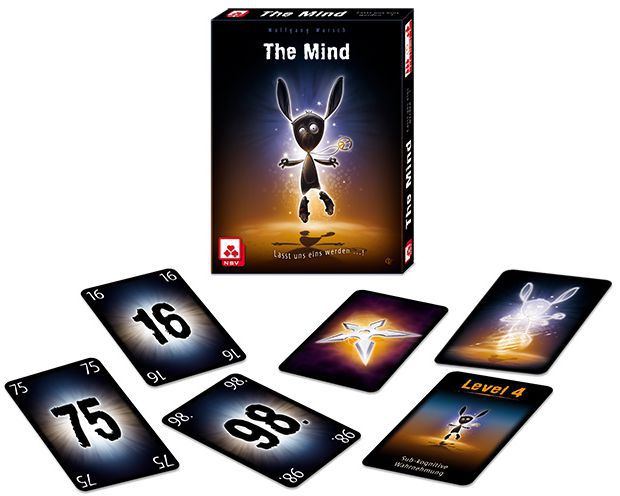
The Mind is more than just a game. It's an experiment, a journey, a team experience in which you can't exchange information, yet will become one to defeat all the levels of the game. In more detail, the deck contains cards numbered 1-100, and during the game you try to complete 12, 10, or 8 levels of play with 2, 3, or 4 players. In a level, each player receives a hand of cards equal to the number of the level: one card in level 1, two cards in level 2, etc. Collectively you must play these cards into the center of the table on a single discard pile in ascending order but you cannot communicate with one another in any way as to which cards you hold. You simply stare into one another's eyes, and when you feel the time is right, you play your lowest card. If no one holds a card lower than what you played, great, the game continues! If someone did, all players discard face up all cards lower than what you played, and you lose one life. You start the game with a number of lives equal to the number of players. Lose all your lives, and you lose the game. You start with one shuriken as well, and if everyone wants to use a shuriken, each player discards their lowest card face up, giving everyone information and getting you closer to completing the level. As you complete levels, you might receive a reward of a shuriken or an extra life. Complete all the levels, and you win! For an extra challenge, play The Mind in extreme mode with all played cards going onto the stack face down. You don't look at the cards played until the end of a level, losing lives at that time for cards played out of order.
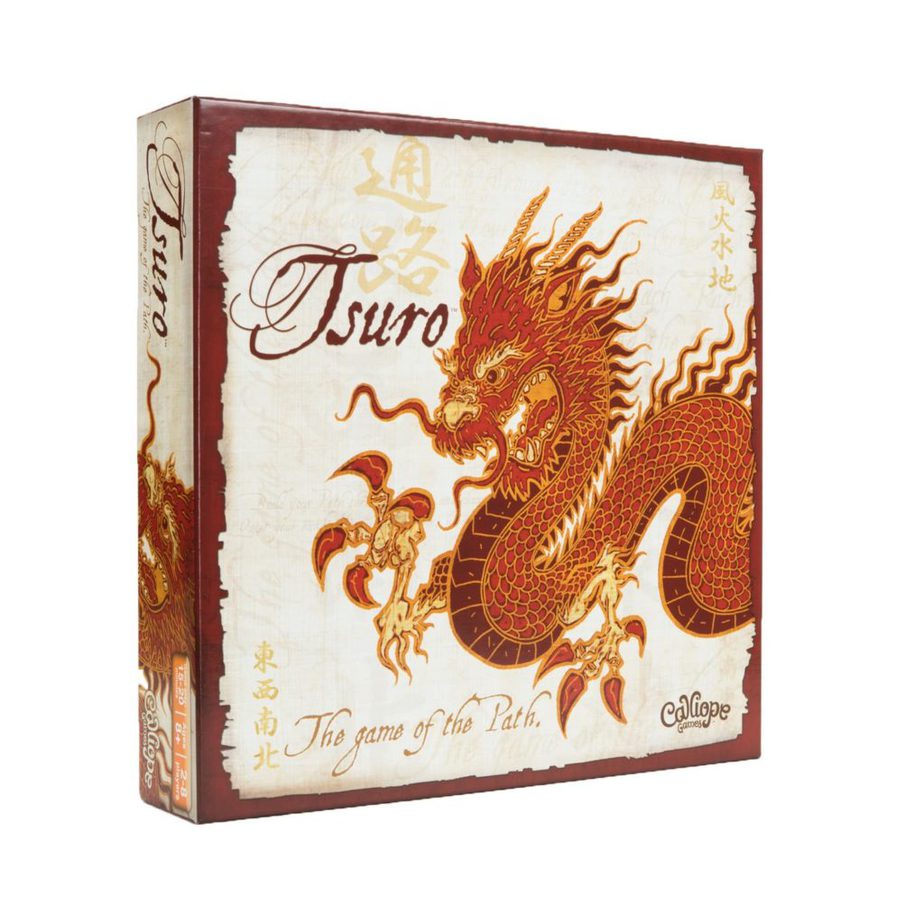
From the publisher: A beautiful and beautifully simple game of laying a tile before your own token to continue its path on each turn. The goal is to keep your token on the board longer than anyone else's, but as the board fills up this becomes harder because there are fewer empty spaces left... and another player's tile may also extend your own path in a direction you'd rather not go. Easy to introduce to new players, Tsuro lasts a mere 15 minutes and actually does work for any number from 2 to 8. Theme: Tsuro has an Asian spiritual theme - the lines representing the "many roads that lead to divine wisdom", and the game as a whole representing "the classic quest for enlightenment". This theme is very light and the game essentially plays as an abstract. Gameplay: The game consists of tiles with twisting lines on them, a 6x6 grid on which to lay these tiles and a token for each player. Each player has a hand of tiles. On your turn you do two things: place a tile from your hand onto the board next to your token and move your token as far as it can go along the line it is currently on, until it is stopped by an empty space with no tile in (yet), the edge of the board or colliding with another player's token. If your token reaches the edge of the board or collides with another player's token, you are out of the game. The aim of the game is to be the last player left with a token on the board. Strategy therefore consists of trying to drive your opponents either into each other or off the board whilst extending your own route in directions that will make it difficult for your opponents to do the same. Other notes: Tsuro was originally patented by McMurchie in 1979 under the name Squiggle Game, but was apparently not published at that time. Somewhat similar to Metro and Spaghetti Junction.
:strip_icc()/pic5055179.png)
Wavelength is a social guessing game in which two teams compete to read each other's minds. Teams take turns rotating a dial to where they think a hidden bullseye is located on a spectrum. One of the players on your team — the Psychic — knows exactly where the bullseye is, and draws a card with a pair of binaries on it (such as: Job - Career, Rough - Smooth, Fantasy - Sci-Fi, Sad Song - Happy Song, etc). The Psychic must then provide a clue that is *conceptually* where the bullseye is located between those two binaries.

Betrayal at House on the Hill quickly builds suspense and excitement as players explore a haunted mansion of their own design, encountering spirits and frightening omens that foretell their fate. With an estimated one hour playing time, Betrayal at House on the Hill is ideal for parties, family gatherings or casual fun with friends. Betrayal at House on the Hill is a tile game that allows players to build their own haunted house room by room, tile by tile, creating a new thrilling game board every time. The game is designed for three to six people, each of whom plays one of six possible characters. Secretly, one of the characters betrays the rest of the party, and the innocent members of the party must defeat the traitor in their midst before it’s too late! Betrayal at House on the Hill will appeal to any game player who enjoys a fun, suspenseful, and strategic game. Betrayal at House on the Hill includes detailed game pieces, including character cards, pre-painted plastic figures, and special tokens, all of which help create a spooky atmosphere and streamline game play. An updated reprint of Betrayal at House on the Hill was released on October 5, 2010.
Cairn is an adventure game for one facilitator (the Warden) and at least one other player. Players act as hardened adventurers, exploring a dark, mysterious Wood filled with strange folk, hidden treasure and unspeakable monstrosities.
/pic6312644.png)
The stakes are high in this high-energy, competitive, and cut-throat, set-collection card game from Grandpa Beck's Games! In Cover Your Assets, players compete to become the first millionaire by building towers of matching sets made from 10 different types of asset cards (things like jewels, piggy banks, classic autos, and more). Each new set that is created is stacked crosswise on top of the previous set, covering, and protecting, all the sets beneath it. The top set of assets in your pile is vulnerable, and can be stolen by other players if they show you a matching asset card, or wild (which are Silver and Gold cards) from their hand. You can defend your stack by showing the challenger a matching card from your own hand. If you do, they can counter with another matching card of their own. The battle rages back and forth until one player can't respond, or bows out. If you win, you keep the set, if the challenger wins, they take the set. Regardless of who wins, ALL the cards used in the challenge are added to the set, increasing its value and allure to other players. To keep the set from being stolen by another player, the best thing you can do is to Cover Your Assets, by creating a new pair from your hand, or by stealing a set from the top of another player's stack during your next turn. At the end of the round scores are tallied, the cards are shuffled, and a new round begins. The first player to reach $1,000,000 wins! Cover Your Assets is quick to learn, and simple to play, yet surprisingly addictive and strategic. The game plays with 4-6 players, and is a great for mixed groups as kids, teens, parents, and grandparents alike can learn the game in minutes and enjoy it for hours. The 2021 edition contains advanced rules, new cards, and rules for 2 & 3 players! Be warned: This is not a good game for sore losers!
:strip_icc()/pic518540.jpg)
Each turn in Dixit, one player is the storyteller who chooses one of the six cards in their hand, then expresses an idea, with sounds or words, that is reflected on that card's image, and places the card face down on the playing surface. Each other player then selects the card that best matches that expression, and passes the selected card to the storyteller, face down.
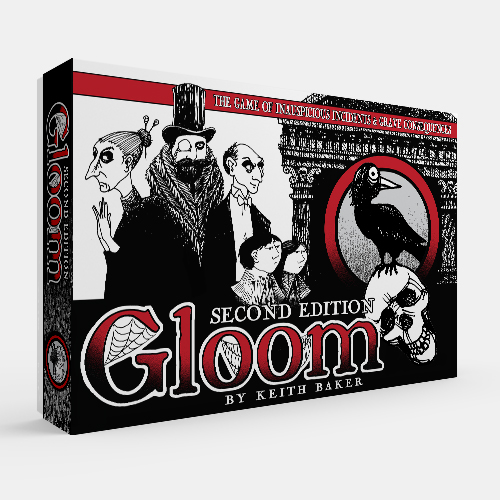
The world of Gloom is a sad and benighted place. The sky is gray, the tea is cold, and a new tragedy lies around every corner. Debt, disease, heartache, and packs of rabid flesh-eating mice—just when it seems like things can't get any worse, they do. But some say that one's reward in the afterlife is based on the misery endured in life. If so, there may yet be hope—if not in this world, then in the peace that lies beyond. In the Gloom card game, you assume control of the fate of an eccentric family of misfits and misanthropes. The goal of the game is sad, but simple: you want your characters to suffer the greatest tragedies possible before passing on to the well-deserved respite of death. You'll play horrible mishaps like Pursued by Poodles or Mocked by Midgets on your own characters to lower their Self-Worth scores, while trying to cheer your opponents' characters with marriages and other happy occasions that pile on positive points. The player with the lowest total Family Value wins. Printed on transparent plastic cards, Gloom features an innovative design by noted RPG author Keith Baker. Multiple modifier cards can be played on top of the same character card; since the cards are transparent, elements from previously played modifier cards either show through or are obscured by those played above them. You'll immediately and easily know the worth of every character, no matter how many modifiers they have. You've got to see (through) this game to believe it!
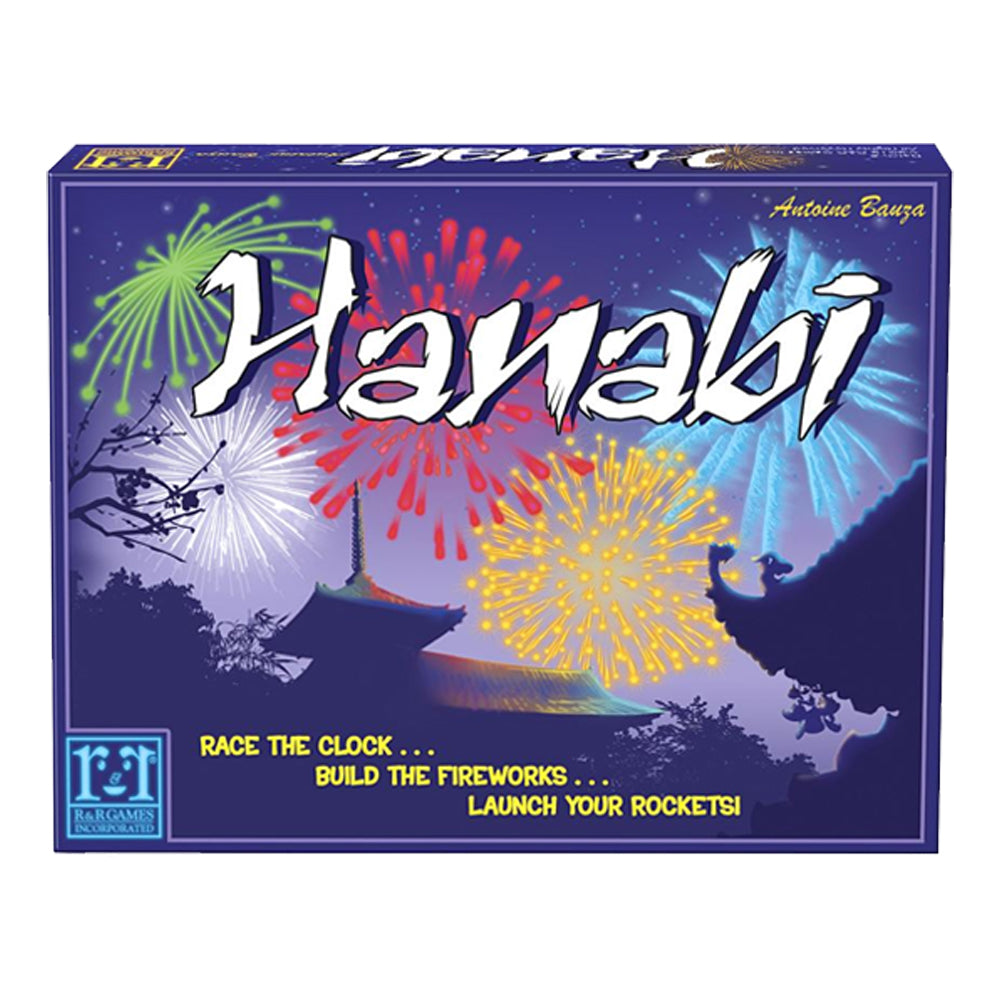
Hanabi—named for the Japanese word for "fireworks"—is a cooperative game in which players try to create the perfect fireworks show by placing the cards on the table in the right order. (In Japanese, hanabi is written as 花ç«; these are the ideograms flower and fire, respectively.) The card deck consists of five different colors of cards, numbered 1–5 in each color. For each color, the players try to place a row in the correct order from 1–5. Sounds easy, right? Well, not quite, as in this game you hold your cards so that they're visible only to other players. To assist other players in playing a card, you must give them hints regarding the numbers or the colors of their cards. Players must act as a team to avoid errors and to finish the fireworks display before they run out of cards. An extra suit of cards, rainbow colored, is also provided for advanced or variant play. Hanabi was originally published as part of Hanabi & Ikebana.
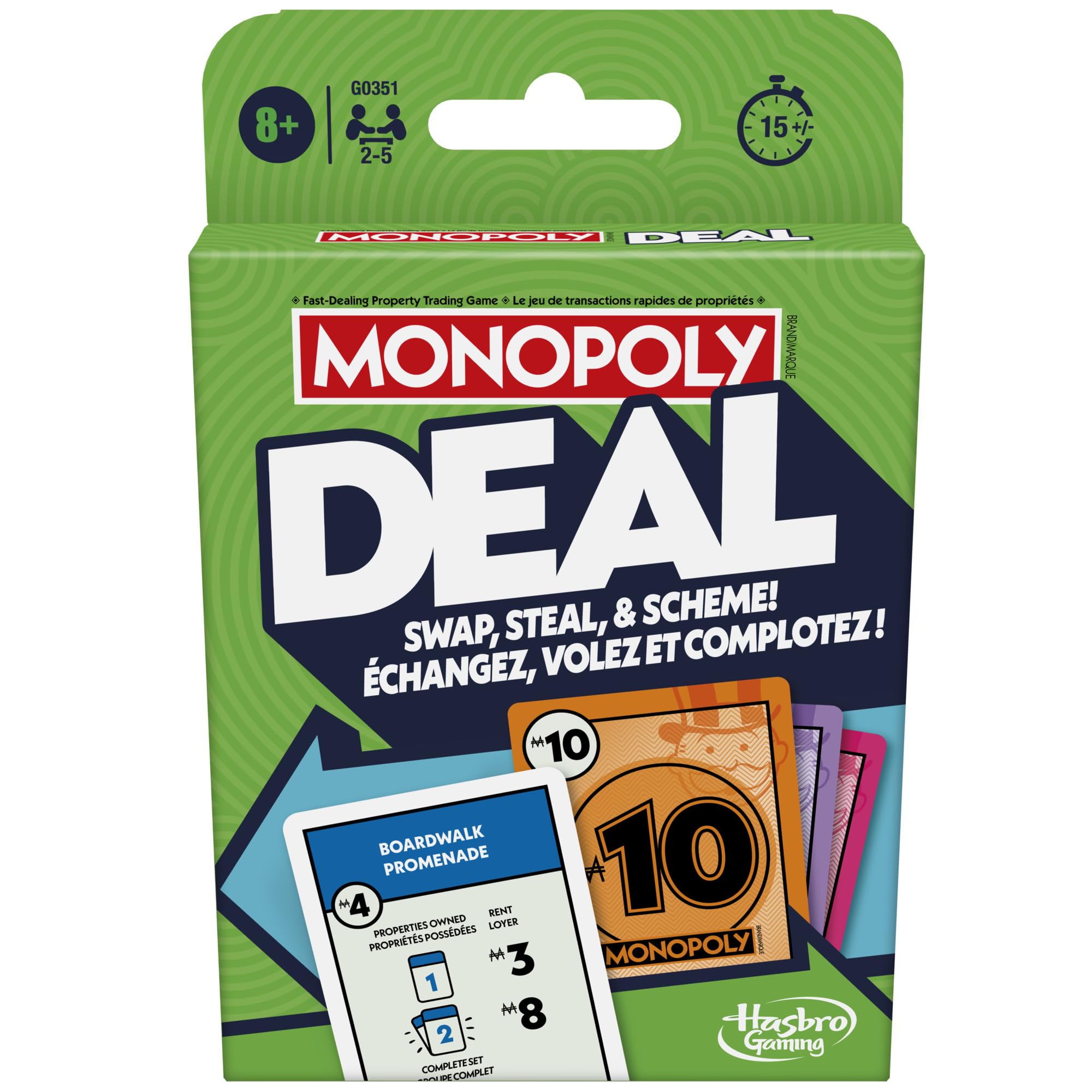
From the back of the box: Fast-dealing, card-stealing fun! Enjoy the rollercoaster experience of Monopoly in just 15 minutes! Collect full property sets to win! This is the "lite" version of Monopoly Deal Card Game, distributed by Wm Morrison Supermarkets PLC (UK) consisting of 52 cards for 2-3 players including 3 Forced Purchase cards, 6 sets of property cards, wildcards, action cards and money cards. Morrisons is printed on the promotional card. For more infomation see Free card games at Morrisons (UK) thread. Also sold through "Sue Ryder" (UK) charity shops (2015). Also sold through "REWE" (GER) supermarkets (2018).
:strip_icc()/pic5240549.png)
Point Salad is a fast and fun card drafting game for the whole family. There are over 100 ways to score points. Players may use a variety of strategies and every game of Point Salad is unique!
:strip_icc()/pic5988903.jpg)
The Crew: Mission Deep Sea plunges players into a cooperative card game unlike any other. As members of a deep-sea expedition, you and your fellow crew are on a quest to locate the lost continent of Mu—but your success depends on precision, teamwork, and a shared sense of timing.
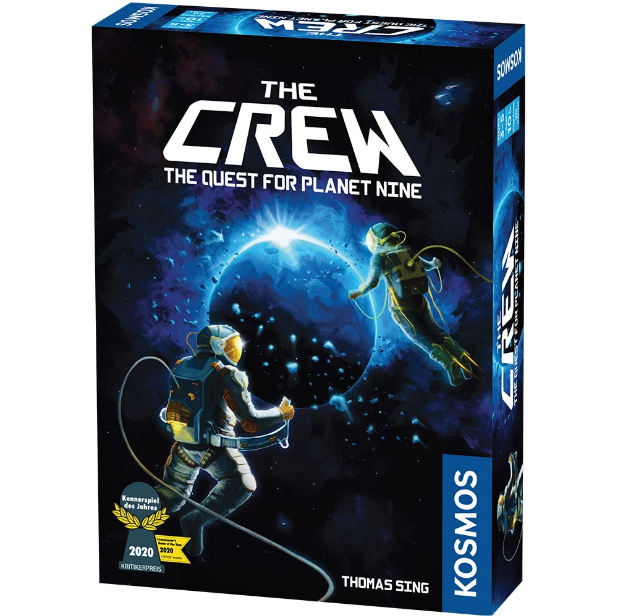
In the co-operative trick-taking game The Crew: The Quest for Planet Nine, the players set out as astronauts on an uncertain space adventure. What are the rumors regarding the unknown planet about? The eventful journey through space extends over 50 exciting missions. But this game can only be defeated by meeting common individual tasks of each player. In order to meet the varied challenges communication is essential in the team. But this is more difficult than expected in space. With each mission the game becomes more difficult. After each mission the game can be paused and continued later. During each mission it is not the number of tricks but the right tricks at the right time that count. The team completes a mission only if every single player is successful in fulfilling their tasks. The game comes with 50 missions, with three additional missions published in spielbox 2/2020.

Ticket to Ride: Europe takes you on a new train adventure across Europe. From Edinburgh to Constantinople and from Lisbon to Moscow, you'll visit great cities of turn-of-the-century Europe. Like the original Ticket to Ride, the game remains elegantly simple, can be learned in 5 minutes, and appeals to both families and experienced gamers. Ticket to Ride: Europe is a complete, new game and does not require the original version. More than just a new map, Ticket to Ride: Europe features brand new gameplay elements. Tunnels may require you to pay extra cards to build on them, Ferries require locomotive cards in order to claim them, and Stations allow you to sacrifice a few points in order to use an opponent's route to connect yours. The game also includes larger format cards and Train Station game pieces. The overall goal remains the same: collect and play train cards in order to place your pieces on the board, attempting to connect cities on your ticket cards. Points are earned both from placing trains and completing tickets but uncompleted tickets lose you points. The player who has the most points at the end of the game wins. Copyright 2002-2014 Days of Wonder, inc. Part of the Ticket to Ride series.

In Ultimate Werewolf Extreme, 3-25 players will use their wits to deceive and uncover deception by fellow players as they attempt to discover who among them is a werewolf. Like traditional werewolf games, Ultimate Werewolf Extreme has all sorts of roles and a moderator to run the game, but Extreme reworks this in several ways: A free, moderator assisting app that helps create and execute games with ease - automatically scanning each player's face and role using micro QR code technology An abundance of information on each card: role name, role description, role art, team, traditional balance value, info value, moderator difficulty, wake order, wake frequency, game length impact, and special considerations. A new role-balancing system based on information vs. the number of werewolves in any size game. Optional rules to increase difficulty, such as invisible Lycans, alternate nominees, celebrations after werewolf elimination that reduce village abilities, and elected judges that determine whether a nominated player is eliminated or not. Enough cards in the base game to play three simultaneous games of Ultimate Werewolf Extreme. Most importantly, the game is integrated with a new app that makes moderating easier than ever before. No more writing down all of the roles and who is assigned to them, or trying to remember some of the complex interactions that happen when using multiple special abilities. The app has two major parts: A deck configuration tool, and a game moderator assistant. The deck configuration tool creates a deck based on user-set parameters, such as number of players, moderator difficulty, info value, or traditional role balance. The game moderator assistant automatically scans cards, player names, and player faces, placing them into the app and using that information to run the game. While a moderator is still required to run the game and monitor the app, much of the critical bookkeeping, such as tracking the players who are still in the game, which actions should happen in what order at night, and timing each of the games all happen automatically. This app is not needed to play, but it will make moderating a breeze with a timer, turn order, and loads of special features! —description from the publisher
/pic3823440.jpg)
Your competitors are out to kill your fish! Can you protect yourself and swim upstream quickly enough to survive? Everyone plays at once in this fast-paced card game. Players compete and collaborate in a cutthroat fight for survival. If you can swim to the finish, you can win! Object of the Game: Play one FISH card that no opponent can kill. How to Play: This game is not played in turns. Players may play cards onto the discard pile at any time. Players only draw cards if they invoke the Flint Flush rule (player has no FISH cards in their hand so they discard all cards and redraw a new hand.)

Carcassonne is a tile-placement game in which the players draw and place a tile with a piece of southern French landscape on it. The tile might feature a city, a road, a cloister, grassland or some combination thereof, and it must be placed adjacent to tiles that have already been played, in such a way that cities are connected to cities, roads to roads, etcetera. Having placed a tile, the player can then decide to place one of their meeples on one of the areas on it: on the city as a knight, on the road as a robber, on a cloister as a monk, or on the grass as a farmer. When that area is complete, that meeple scores points for its owner. During a game of Carcassonne, players are faced with decisions like: "Is it really worth putting my last meeple there?" or "Should I use this tile to expand my city, or should I place it near my opponent instead, giving him a hard time to complete their project and score points?" Since players place only one tile and have the option to place one meeple on it, turns proceed quickly even if it is a game full of options and possibilities. First game in the Carcassonne series.
:strip_icc()/pic3056523.png)
Hero Realms is a fantasy-themed deck-building game that is an adaptation of the award-winning Star Realms game. The game includes basic rules for two-player games, along with rules for multiplayer formats such as Free-For-All, Hunter, and Hydra. Each player starts the game with a ten-card personal deck containing gold (for buying) and weapons (for combat). You start each turn with a new hand of five cards from your personal deck. When your deck runs out of cards, you shuffle your discard pile into your new deck. An 80-card Market deck is shared by all players, with five cards being revealed from that deck to create the Market Row. As you play, you use gold to buy champion cards and action cards from the Market. These champions and actions can generate large amounts of gold, combat, or other powerful effects. You use combat to attack your opponent and their champions. When you reduce your opponent's score (called health) to zero, you win! Multiple expansions are available for Hero Realms that allow players to start as a particular character (Cleric, Fighter, Ranger, Thief, or Wizard) and fight cooperatively against a Boss, fight Boss decks against one another, or compete in a campaign mode that has you gain experience to work through different levels of missions.
:strip_icc()/pic5019036.jpg)
The stakes have been raised. Imagine living in a place so wretched that it's not plagued by one, two, or even three monsters — but seven of the most horrifying fiends! In this game, you'll come face to face with them all as you work together to rid the town of the maniacal or misunderstood creatures…before it's too late. Horrified includes high-quality sculpted miniatures (Frankenstein, The Bride of Frankenstein, The Wolf Man, Dracula, The Mummy, The Invisible Man, Creature from the Black Lagoon). Its innovative, easy-to-learn, cooperative gameplay has players working together against the monsters with varying levels of difficulty. Just as each monster is unique, they require different strategies and tactics to be defeated. —description from the publisher
Horrified: American Monsters is a standalone game that features gameplay similar to 2019's Horrified, which challenges players to overcome the "Universal Monsters" from classic films. In this co-operative game, you face off against classic American nightmarish beasts: Bigfoot, Mothman, the Jersey Devil, the Chupacabra, the Banshee of the Badlands, and the Ozark Howler. The more creatures in the game, the harder the challenge, with players needing to use their unique powers to figure out how to defeat each monster.

In Pandemic, several virulent diseases have broken out simultaneously all over the world! The players are disease-fighting specialists whose mission is to treat disease hotspots while researching cures for each of four plagues before they get out of hand. The game board depicts several major population centers on Earth. On each turn, a player can use up to four actions to travel between cities, treat infected populaces, discover a cure, or build a research station. A deck of cards provides the players with these abilities, but sprinkled throughout this deck are Epidemic! cards that accelerate and intensify the diseases' activity. A second, separate deck of cards controls the "normal" spread of the infections. Taking a unique role within the team, players must plan their strategy to mesh with their specialists' strengths in order to conquer the diseases. For example, the Operations Expert can build research stations which are needed to find cures for the diseases and which allow for greater mobility between cities; the Scientist needs only four cards of a particular disease to cure it instead of the normal five—but the diseases are spreading quickly and time is running out. If one or more diseases spreads beyond recovery or if too much time elapses, the players all lose. If they cure the four diseases, they all win! The 2013 edition of Pandemic includes two new characters—the Contingency Planner and the Quarantine Specialist—not available in earlier editions of the game. Pandemic is the first game in the Pandemic series.

Paranoia is a game of tiles fast-paced and furious. And that happens because there are no turns. As in a discussion without a moderator, where no one respects the word and all speak at once, in Paranoia all play at once. But, in the middle of this whirlpool, there are rules that everyone must respect and give the game a fair balance between the noise and reflection, between order and chaos ... Initially, all players receive 10 hexagonal tiles and they must put them in their stand. The objective is to be the first to play all your pieces.
:strip_icc()/pic4427323.jpg)
In the multiplayer puzzle game Railroad Ink, your goal is to connect as many exits on your board as possible. Each round, a set of dice are rolled in the middle of the table, determining which kind of road and railway routes are available to all players. You have to draw these routes on your erasable boards to create transport lines and connect your exits, trying to optimize the available symbols better than your opponents.

Choose your dice cleverly in Ganz schön clever (German for "That's Pretty Clever") to enter them into the matching colored areas on your score sheet, putting together tricky chain-scoring opportunities, and racking up the points! The dice you don't use are as important as those you do, because every die with a lower value than the chosen one can be used by the other players, keeping everyone in the game at all times.
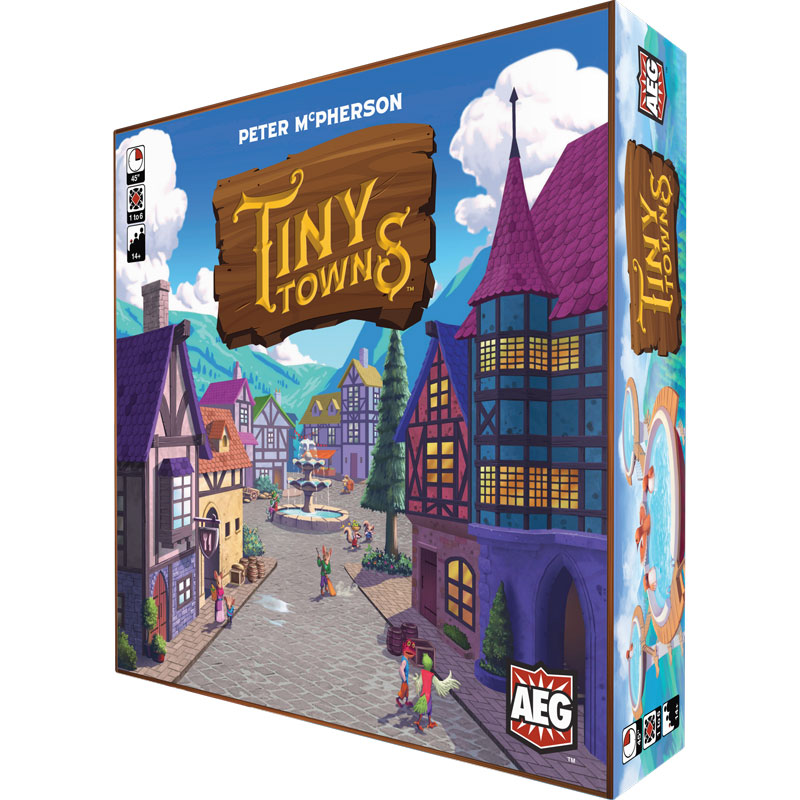
You are the mayor of a tiny town in the forest in which the smaller creatures of the woods have created a civilization hidden away from predators. This new land is small and the resources are scarce, so you take what you can get and never say no to building materials. Cleverly plan and construct a thriving town, and don't let it fill up with wasted resources! Whoever builds the most prosperous tiny town wins! In Tiny Towns, your town is represented by a 4x4 grid on which you will place resource cubes in specific layouts to construct buildings. Each building scores victory points (VPs) in a unique way. When no player can place any more resources or construct any buildings, the game ends, and any squares without a building are worth -1 VP. The player with the most VP wins! —description from publisher
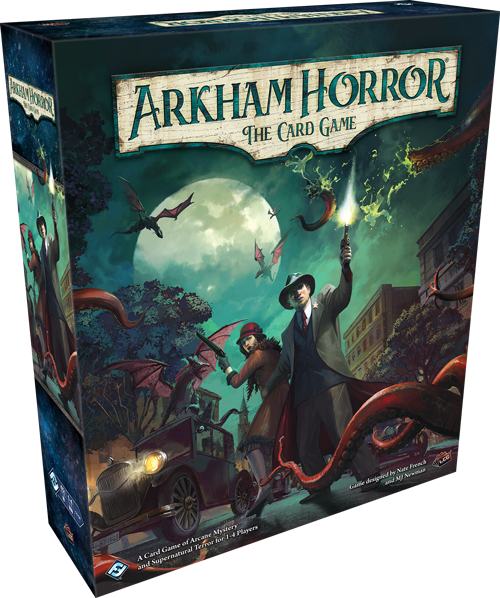
The boundaries between worlds have drawn perilously thin… Arkham Horror: The Card Game is a cooperative Living Card Game® set amid a backdrop of Lovecraftian horror. As the Ancient Ones seek entry to our world, one to four investigators work to unravel arcane mysteries and conspiracies. Their efforts determine not only the course of your game, but carry forward throughout whole campaigns, challenging them to overcome their personal demons even as Arkham Horror: The Card Game blurs the distinction between the card game and roleplaying experiences.

Introduced by the Moors, azulejos (originally white and blue ceramic tiles) were fully embraced by the Portuguese when their king Manuel I, on a visit to the Alhambra palace in Southern Spain, was mesmerized by the stunning beauty of the Moorish decorative tiles. The king, awestruck by the interior beauty of the Alhambra, immediately ordered that his own palace in Portugal be decorated with similar wall tiles. As a tile-laying artist, you have been challenged to embellish the walls of the Royal Palace of Evora. In the game Azul, players take turns drafting colored tiles from suppliers to their player board. Later in the round, players score points based on how they've placed their tiles to decorate the palace. Extra points are scored for specific patterns and completing sets; wasted supplies harm the player's score. The player with the most points at the end of the game wins.

You and your fledgling crew must thrive amidst the threats of rival gangs, powerful noble families, vengeful ghosts, the Bluecoats of the city watch, and the siren song of your scoundrel’s own vices. Will you rise to power in the criminal underworld? What are you willing to do to get to the top?
Inspired by a love of classic video games, Boss Monster: The Dungeon Building Card Game pits 2-4 players in a competition to build the ultimate side-scrolling dungeon. Players compete to lure and destroy hapless adventurers, racing to outbid one another to see who can build the most enticing, treasure-filled dungeon. The goal of Boss Monster is to be the first Boss to amass ten Souls, which are gained when a Hero is lured and defeated — but a player can lose if his Boss takes five Wounds from Heroes who survive his dungeon. Playing Boss Monster requires you to juggle two competing priorities: the need to lure Heroes at a faster rate than your opponents, and the need to kill those Heroes before they reach your Boss. Players can build one room per turn, each with its own damage and treasure value. More attractive rooms tend to deal less damage, so a Boss who is too greedy can become inundated with deadly Heroes. Players interact with each other by building rooms and playing Spells. Because different Heroes seek different treasure types, and rooms are built simultaneously (played face down, then revealed), this means that every "build phase" is a bidding war. Spells are instant-speed effects that can give players advantages or disrupt opponents. As a standalone card game with 155 cards, Boss Monster contains everything that 2-4 players need to play.

Driven from lands farther north by more powerful dragons, a young white dragon named Cryovain has descended upon the Sword Mountains, claiming the snow-capped range as its domain.

In Disney Villainous: Perfectly Wretched, each player takes control of one of three Disney characters, each one a villain in a different Disney movie, specifically Cruella de Vil from 101 Dalmatians, Mother Gothel from Tangled, and Pete from Steamboat Willie. Each player has their own villain deck, fate deck, player board, and 3D character. On a turn, the active player moves their character to a different location on their player board, takes one or more of the actions visible on that space (often by playing cards from their hand), then refills their hand to four cards. Cards are allies, items, effects, and conditions. You need to use your cards to fulfill your unique win condition. One of the actions allows you to choose another player, draw two cards from that player's fate deck, then play one of them on that player's board, covering two of the four action spaces on one of that player's locations. The fate deck contains heroes, items, and effects from that villain's movie, and these cards allow other players to mess with that particular villain. Disney Villainous: Perfectly Wretched is playable on its own, and its characters can also face off against those in the Disney Villainous base game from 2018 and the Disney Villainous: Wicked to the Core and Disney Villainous: Evil Comes Prepared standalone games in 2019.
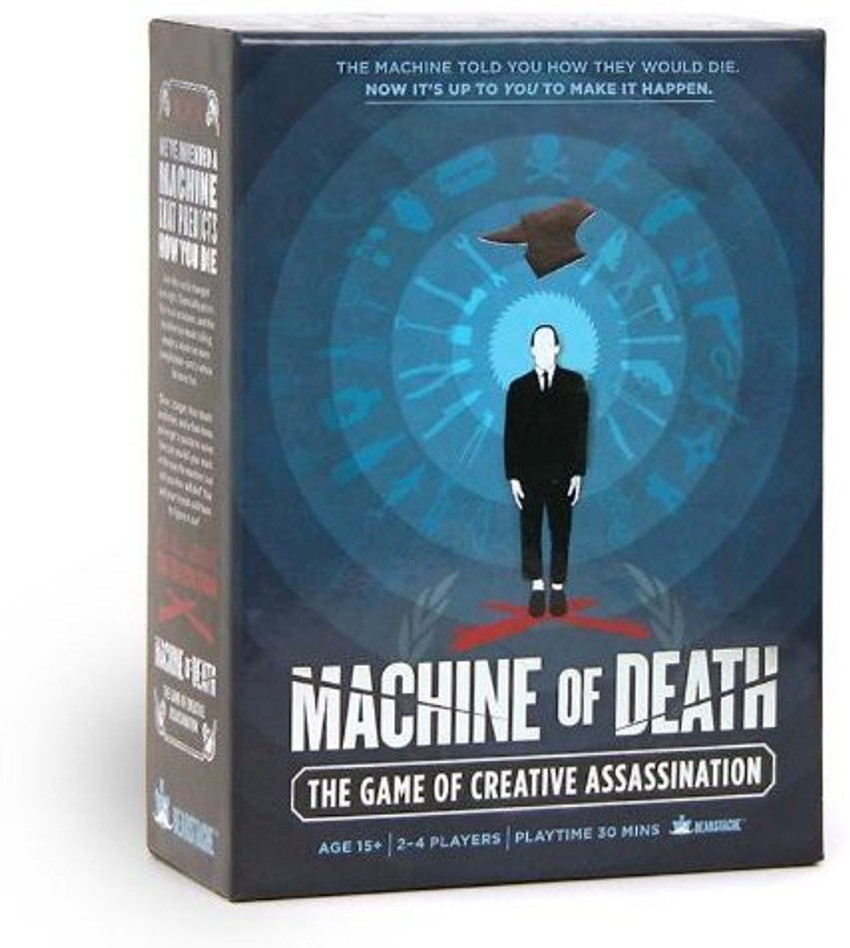
Machine of Death: The Game of Creative Assassination is a storytelling game set in a world in which a machine can predict how a person will die with 100% accuracy with only a small blood sample. However, the machine delights in being vague and twisted. A card reading "Old Age" could mean you die in your sleep at age 120, or it could mean you're run over tomorrow by an elderly driver who forgot to take his pills today. Players of the game take the role of assassins, who must use the various tools at their disposal -- from storytelling to a slew of items available from specialty Black Market shops -- to create a situation in which a target is killed in a way in line with their Death Prediction. The Machine of Death Game uses this basic idea, of assassins working in a world where cause of death is known to create various game modes. The General Gameplay of most modes works like this: A target is assigned, and given certain details (including Death Prediction, and extra Intel details, such as things they particularly like or dislike – to help predict their behavior). Players – assassins – are given Black Market Gift Cards. These are the items they are allowed to use in order to accomplish their goal: killing the target. Players use the Gift Cards to devise a plan. Each Black Market card provides an item to be used in an Action. Three actions should chain together in some way that results in the death of the target. The plan is greenlit, either by a Chief player, or via consensus, depending on game mode. The timer starts and the plan is put into action. This is represented by dice rolling to beat a "difficulty score." An unlikely plan hinging on a single item may need to roll a 6 for that Action, but a rock-solid intricate plan may need to only roll a 2 for each card. The skull face on the die also adds a frantic element (replacing the 1 face, if the skull is rolled it prompts the flipping of a Fate Coin to add additional randomness). In case of failure of any die roll, that Action didn't work, and the plan must be revised. While the timer continues running, the assassins draw a new Black Market item, amending their previous plan and rolling for a new Action. They may also call in "Specialists", who are characters with special skills (earned in previous rounds). If any three Actions are successful before the timer runs out, the target is killed. With the remaining time, the players may roll for Aftermath tasks (such as fleeing the scene or destroying the evidence). Completion of these tasks earns Specialist cards to be used in later rounds. This is the only way to replenish the group's overall Budget of playable cards. If the timer runs out before three Actions are completed, the target escapes. This is the end of the round. In the published rules, this also ends the game. This rule was subsequently revised, allowing players to make another attempt on the same target, or take the loss and move on to additional targets. Hard-core players may end the game at this point. The team wins if they can accomplish four successful kills before their total Budget of Black Market cards are exhausted. Game Variants: Chief Mode is where one player takes on the gamemaster role of the Chief, answering questions and deciding on the difficulty of the plan being created by the other players. Groups of 4 or more work best in this mode. In groups of 2-3 players, each player states their opinion, and the hardest value is the one used. Psychopath is similar to Cards Against Humanity or Apples to Apples. Each player holds a hand of Death Prediction cards that represent hostages. One psychopath announces a murder weapon (based on a drawn Black Market card), and players each toss in the hostage they believe will be most likely to be killed by that weapon. Designed for 4+ players. Speed Round is faster-paced and useful for introducing players to the death prediction concept. One Chief presents the Death Prediction Card of an assassination target, and players rush to play a Black Market or Specialist card that they think can kill the person in the predicted way. The Chief assigns a difficulty value to the fastest player's proposed plan, and the player rolls to see if they can pull it off. If they do, they earn that Death Prediction Card as a point; if they fail, another player may propose a plan. Mechanical Chief uses 14 regular playing cards to replace the subjective judgments of the Chief. Each Black Market card is dealt with a playing card, the value of which is kept hidden until the die is about to be rolled. This variant is good for faster play, and directs discussions toward justifying the revealed values within the story, rather than debating the merits of various plans. Teams is useful for very large groups. The players split into two rival assassination teams, and alternate attacking targets, with a single Chief moderating. Teams operate under spelling bee elimination rules (one team's failure, followed by the victory of the other, results in the first team's elimination). A target that a team fails to kill must then be attempted by the other team, and a continuous narrative persists throughout the entire game.
:strip_icc()/pic4933104.jpg)
Sub Terra II: Inferno's Edge is a cooperative adventure board game. You and up to five friends must explore a tile-based volcano temple to steal a legendary artifact. To get it, you must find the path to the inner sanctum, unlock the secrets within, then escape the way you came. This is a dangerous place. You'll need to work as a team to avoid deadly traps, brave scorching lava and defeat the temple's mysterious guardians. Stick together to share your skills, or split up to cover more ground. But beware - the volcano stirs beneath you, and you're running out of time...
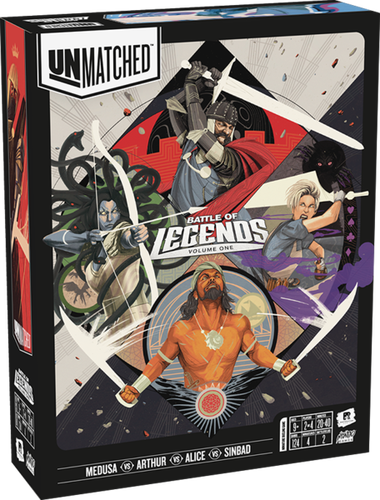
In battle, there are no equals. Unmatched is a highly asymmetrical miniature fighting game for two or four players. Each hero is represented by a unique deck designed to evoke their style and legend. Tactical movement and no-luck combat resolution create a unique play experience that rewards expertise, but just when you've mastered one set, new heroes arrive to provide all new match-ups. Battle of Legends, Volume One features four heroes. King Arthur sacrifices cards to power up his attacks and gets some timely assistance from Merlin's magic. Alice is back from Wonderland with a giant vorpal blade and the Jabberwock by her side as she grows and shrinks to gain advantages on attack and defense. Medusa is happy to attack from range and let her harpies hound you, but just one devastating glance could end the battle quickly. Sinbad grows in power as he gains experience on each of his voyages. Combat is resolved quickly by comparing attack and defense cards. However, each card's unique effects and a simple but deep timing system lead to interesting decisions each time. The game also features an updated version of the line-of-sight system from Tannhäuser for ranged attacks and area effects. The game includes a double-sided board with two different battlefields, pre-washed miniatures for each hero, and custom life trackers that's brought to life with the stunning artwork of Oliver Barrett and the combined design teams of Restoration Games and Mondo Games.
:strip_icc()/pic7149798.jpg)
You are the leader of one of the 7 great cities of the Ancient World. Gather resources, develop commercial routes, and affirm your military supremacy. Build your city and erect an architectural wonder which will transcend future times. 7 Wonders lasts three ages. In each age, players receive seven cards from a particular deck, choose one of those cards, then pass the remainder to an adjacent player. Players reveal their cards simultaneously, paying resources if needed or collecting resources or interacting with other players in various ways. (Players have individual boards with special powers on which to organize their cards, and the boards are double-sided). Each player then chooses another card from the deck they were passed, and the process repeats until players have six cards in play from that age. After three ages, the game ends. In essence, 7 Wonders is a card development game. Some cards have immediate effects, while others provide bonuses or upgrades later in the game. Some cards provide discounts on future purchases. Some provide military strength to overpower your neighbors and others give nothing but victory points. Each card is played immediately after being drafted, so you'll know which cards your neighbor is receiving and how her choices might affect what you've already built up. Cards are passed left-right-left over the three ages, so you need to keep an eye on the neighbors in both directions. Though the box of earlier editions is listed as being for 3–7 players, there is an official 2-player variant included in the instructions.

In Villainous, each player takes control of one of six Disney characters, each one a villain in a different Disney movie. Each player has their own villain deck, fate deck, player board, and 3D character. On a turn, the active player moves their character to a different location on their player board, takes one or more of the actions visible on that space (often by playing cards from their hand), then refills their hand to four cards. Cards are allies, items, effects, conditions, and (for some characters) curses. You need to use your cards to fulfill your unique win condition. One of the actions allows you to choose another player, draw two cards from that player's fate deck, then play one of them on that player's board, covering two of the four action spaces on one of that player's locations. The fate deck contains heroes, items, and effects from that villain's movie, and these cards allow other players to mess with that particular villain.
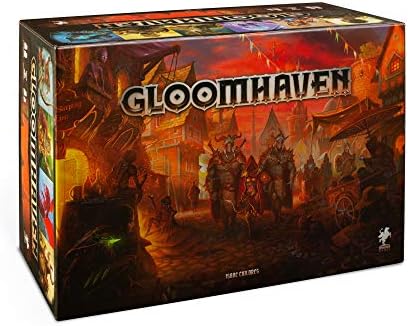
Gloomhaven is a game of Euro-inspired tactical combat in a persistent world of shifting motives. Players will take on the role of a wandering adventurer with their own special set of skills and their own reasons for traveling to this dark corner of the world. Players must work together out of necessity to clear out menacing dungeons and forgotten ruins. In the process, they will enhance their abilities with experience and loot, discover new locations to explore and plunder, and expand an ever-branching story fueled by the decisions they make. This is a game with a persistent and changing world that is ideally played over many game sessions. After a scenario, players will make decisions on what to do, which will determine how the story continues, kind of like a “Choose Your Own Adventure” book. Playing through a scenario is a cooperative affair where players will fight against automated monsters using an innovative card system to determine the order of play and what a player does on their turn. Each turn, a player chooses two cards to play out of their hand. The number on the top card determines their initiative for the round. Each card also has a top and bottom power, and when it is a player’s turn in the initiative order, they determine whether to use the top power of one card and the bottom power of the other, or vice-versa. Players must be careful, though, because over time they will permanently lose cards from their hands. If they take too long to clear a dungeon, they may end up exhausted and be forced to retreat.
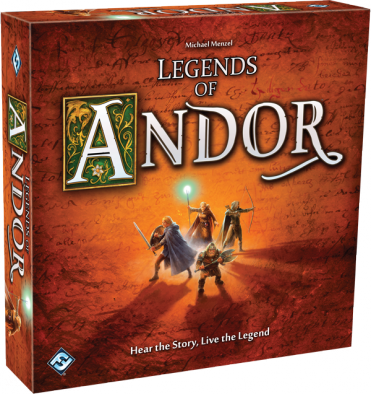
Legends of Andor is a cooperative adventure board game for two to four players in which a band of heroes must work together to defend a fantasy realm from invading hordes. To secure Andor's borders, the heroes will embark on dangerous quests over the course of five unique scenarios (as well as a final scenario created by the players themselves). But as the clever game system keeps creatures on the march toward the castle, the players must balance their priorities carefully. At the heart of Legends of Andor is its unique narrative, the linked scenarios of which tell an overarching story as the players successfully complete objectives. For each scenario, or "Legend", a legend deck conveys the plot of an ever-unfolding tale...one in which the players are the protagonists. A wooden marker moves along the board's legend track at key points during each scenario, triggering the draw of a new legend card, the introduction of new game-altering effects, and the advancement of the story's plot. In the end, the players must endeavor to guide the fate of Andor through their heroic actions, bringing a happy ending to their epic fantasy tale. Will their heroes roam the land completing quests in the name of glory, or devote themselves to the defense of the realm? Uncover epic tales of glory as you live the Legends of Andor! —description from the publisher
How far are you willing to go for the revolution, and what sacrifices will you make to see the drow in control of Spire once more? Spire is a fantasy-punk roleplaying game of intrigue, subterfuge and sedition. You and your friends will become a cell of desperate drow freedom fighters and claw back control of the city from your aelfir overlords, no matter what it takes. It uses a simple rules system that helps you to tell stories of brutal rebellion where life is cheap, alliances are temporary, and magic is strange and perilous.
:strip_icc()/pic3120646.jpg)
All sorts of gruesome deaths await you and the rest of your wagon party in this official multi-player card game version of the classic computer game. To win you’ll need to keep one player alive all the way from Independence, MO to the Willamette Valley. But between rattlesnakes, starvation, dead oxen, broken bones, dysentery, and a host of other calamities the odds are long . . . almost as long as the Oregon Trail itself.
:strip_icc()/pic6232602.jpg)
You are the founder of a new village during the middle ages, in the years after a great plague. The loss of so many people has created big problems for the survivors. Many of the people the villagers used to depend on for essential things like food, shelter and clothes are gone. Craftsmen find themselves without suppliers of raw materials, traders have lost their customers and many have lost their farms and workshops as they escaped the plague. The roads are full of refugees seeking a new beginning. They come to you, hoping to settle down on your land and make a living. Your grain farm is the ideal starting point for a village, reliably providing food for many people. You must choose wisely who you allow to settle with you, as your food and resources are limited. The people on the road have valuable and unique skills, but they all in turn rely on other people with very specific crafts to be able to work. Raw materials, tools and services must be provided by other people from the road. If you manage to find people that can work together to make a profit, while increasing your food surplus and capacity for building new houses, your village will be prosperous. The game comes with a solo mode where a lone village strives to prosper in spite of the dreaded Countess and her evil machinations. —description from the publisher